
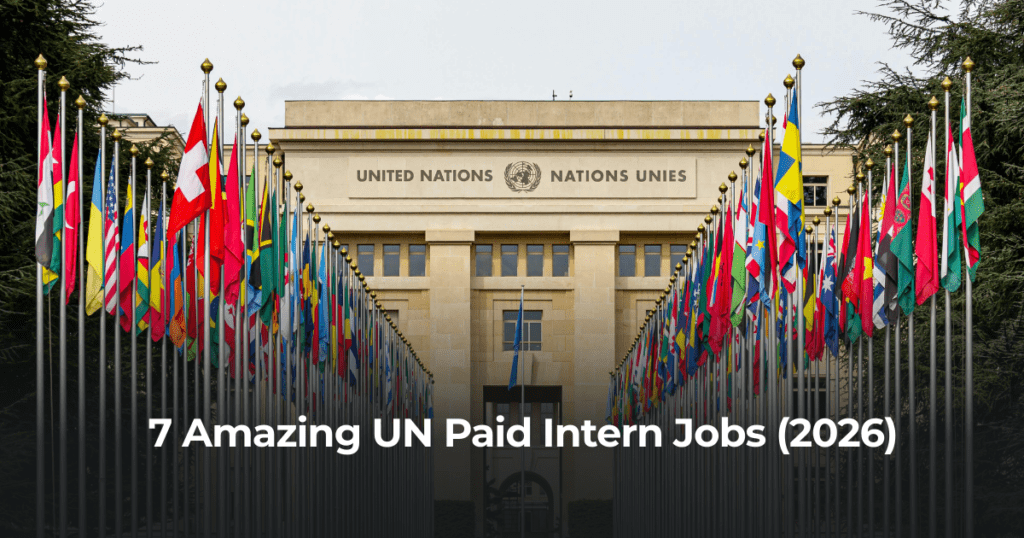
Getting an internship with the United Nations is a dream for many students and recent graduates—especially if it’s a paid one. A UN internship can give you real international experience, strong references, and a powerful line on your CV that opens doors in NGOs, governments, and global companies.
While many UN internships have traditionally been unpaid, more UN entities now offer stipends or paid intern roles, especially in higher‑cost duty stations. Availability and conditions vary, so you must always read each vacancy carefully.
This guide walks you through 7 types of UN paid (or stipend-supported) intern jobs you can look for in 2026, what you’ll do in each, and how to start preparing now.
Important: UN internship conditions change over time. Always check the official UN and agency career pages for the latest rules, pay information, and eligibility.
Before You Start: How UN Internships Usually Work
Most UN internships:
- Last 3–6 months (sometimes up to 11 months)
- Are full-time (35–40 hours per week)
- Expect you to be:
- Enrolled in a Bachelor’s/Master’s/PhD program, or
- Recently graduated (usually within the last 1–2 years)
- Require good English (French, Spanish, Arabic, or other UN languages are a bonus)
- Are advertised on:
- UN Careers / Inspira (UN Secretariat and many entities)
- Agency websites (UNICEF, UNDP, UNHCR, WHO, etc.)
Paid or stipend-based internships are mentioned clearly in each vacancy notice. If there is no mention of payment, assume it may be unpaid or only partially funded.
1. Human Rights & Refugee Protection Intern
Typical hosts:
- Office of the High Commissioner for Human Rights (OHCHR)
- UN High Commissioner for Refugees (UNHCR)
- UN human rights or protection sections in field missions
What you do
- Assist in researching human rights situations in different countries
- Help draft briefing notes, reports, and case summaries
- Support monitoring and documentation of human rights violations
- Participate in meetings, workshops, and consultations
- Prepare background materials for advocacy and policy discussions
Who it’s for
- Students or graduates in law, international relations, political science, human rights, sociology, or related fields
- Strong interest in refugee rights, protection, and international law
- Excellent written and analytical skills
Why it’s amazing
You see directly how international standards are applied on the ground, and you learn how legal and policy tools are used to protect vulnerable people. It’s especially powerful if you want a future career in UN agencies, NGOs, or international courts.
Paid?
Some field locations or offices offer stipends to help with living costs. Others don’t. Always check the specific vacancy and location.
2. Sustainable Development & Poverty Reduction Intern
Typical hosts:
- United Nations Development Programme (UNDP)
- UN Department of Economic and Social Affairs (UN DESA)
- Regional economic commissions (e.g., ESCAP, ECA, ECLAC)
What you do
- Help analyze data and draft inputs related to the Sustainable Development Goals (SDGs)
- Assist with projects on poverty reduction, gender equality, governance, or climate resilience
- Support workshops, conferences, and consultations with governments and civil society
- Prepare presentations, briefs, and case studies
Who it’s for
- Students in economics, development studies, public policy, international relations, statistics, or similar
- Interested in global development, inequality, and social policy
- Comfortable working with data and reports
Why it’s amazing
You work at the heart of global development, seeing how the UN partners with governments to reach the SDGs. This is ideal if you aim to become a development specialist, policy analyst, or consultant.
Paid?
Many UNDP and related internships now provide stipends, though amounts vary by duty station. Check each posting carefully.
3. Climate & Environment Intern
Typical hosts:
- United Nations Environment Programme (UNEP)
- UN Framework Convention on Climate Change (UNFCCC) secretariat
- UNDP climate and environment units
- Regional environmental offices
What you do
- Support research on climate change, pollution, biodiversity, or sustainable energy
- Draft and edit reports, policy briefs, and web content on environmental topics
- Assist with climate conferences, negotiations, or side events
- Help manage databases, project documents, and communication materials
Who it’s for
- Students in environmental science, climate studies, geography, engineering, public policy, or similar
- Passionate about climate action and environmental protection
- Able to understand both technical data and policy discussions
Why it’s amazing
You get frontline exposure to how global climate agreements and environmental policies come to life. This can lead to careers in environmental NGOs, government ministries, think tanks, or green tech companies.
Paid?
Some offices and duty stations offer monthly stipends for interns, especially in expensive cities. It’s not guaranteed, so always confirm in the vacancy.
4. Communications & Digital Media Intern
Typical hosts:
- UN Department of Global Communications (UN Secretariat)
- UNICEF, UN Women, UNHCR, WFP, WHO and other agencies’ communications teams
- Country and regional offices
What you do
- Create or edit social media content, blog posts, and website articles
- Assist in campaigns, media events, and press releases
- Help produce videos, infographics, and visual content
- Monitor media coverage and social trends related to UN priorities
- Support basic design and layout work (if you have those skills)
Who it’s for
- Students in communications, journalism, marketing, media studies, graphic design, international relations, etc.
- Strong writers, storytellers, or content creators
- Familiar with social platforms and basic analytics
Why it’s amazing
You learn how to turn complex global issues into content that ordinary people understand and care about. This is especially valuable if you want to work in media, digital marketing, advocacy, or public information.
Paid?
A growing number of communications internships offer stipends, particularly in headquarters locations (e.g., Geneva, New York) and some country offices.
5. Data, Research & Policy Analysis Intern
Typical hosts:
- UN Office for the Coordination of Humanitarian Affairs (UNOCHA)
- UN regional economic commissions
- UNDP and World Bank–related projects (though WB isn’t a UN agency)
- Specialized research and statistics units
What you do
- Collect and clean data from different sources
- Help build dashboards, charts, and maps (if you know Excel, R, Python, GIS, or similar tools)
- Draft analytical notes, situation reports, and policy summaries
- Support monitoring of country or regional trends (economic, social, humanitarian)
Who it’s for
- Students in statistics, economics, data science, public policy, computer science, or similar
- Comfortable with data analysis tools and large data sets
- Interested in evidence‑based policy and research
Why it’s amazing
You build hard technical skills while learning how data shapes real decisions in humanitarian and development work. This can launch careers in analytics, monitoring & evaluation, or policy research.
Paid?
Some specialized units and offices offer stipends, especially when advanced technical skills are required.
6. Peace & Security / Political Affairs Intern
Typical hosts:
- UN Department of Political and Peacebuilding Affairs (DPPA)
- Peacekeeping and political missions
- Regional desks at UN headquarters
What you do
- Monitor and summarize political developments, conflicts, and peace processes
- Draft reports, talking points, and background notes for senior officials
- Help prepare meetings, briefings, and Security Council sessions
- Conduct desk research on countries, armed groups, or peace agreements
Who it’s for
- Students in international relations, political science, security studies, conflict resolution, law, etc.
- Deep interest in diplomacy, peace processes, and conflict analysis
- Strong writing and analytical skills
Why it’s amazing
You see how diplomacy, negotiation, and international law are used to prevent or resolve conflicts. This path is ideal if you’re aiming for a career in foreign service, diplomacy, conflict resolution, or think tanks.
Paid?
Compensation depends heavily on the mission and duty station. Some locations may provide stipends, while others may not. Check each specific advert.
7. Administration, HR & Operations Intern
Typical hosts:
- UN Secretariat and field missions
- UNOPS, UNDP, UNICEF, WFP, WHO and other agencies’ operations units
- Regional and country offices
What you do
- Support human resources (recruitment, onboarding, training logistics)
- Assist finance and procurement teams with basic tasks and documentation
- Help with event coordination and internal communications
- Work on office management, logistics, and administrative support
Who it’s for
- Students in business administration, HR, finance, management, public administration, etc.
- Organized, detail‑oriented, and comfortable with office software
- Interested in the behind-the-scenes operations of international organizations
Why it’s amazing
You learn how large global organizations actually function day‑to‑day. This gives you transferable skills for careers in HR, operations, project management, or corporate roles.
Paid?
Operations and HR internships are among those more likely to offer stipends, but this is still not universal. Always verify.
How to Find These UN Internships for 2026
- UN Careers / Inspira
- Go to the official UN careers portal (careers.un.org or the current official domain).
- Filter by:
- Job Network: Political, Economic, Information & Telecommunication, etc.
- Category: Intern
- Duty station: your preferred city or “multiple locations”
- Check each vacancy for:
- Paid / stipend information
- Eligibility (enrolled student or recent graduate)
- Required languages and skills
- Agency-Specific Career Pages
Check the internship sections of agencies like:- UNDP (development and governance)
- UNICEF (children and communication)
- UNHCR (refugees and protection)
- UNEP (environment)
- UN Women (gender equality)
- WFP (food and logistics)
- WHO (health)
- UN Job Aggregator Sites
- Independent sites like unjobs.org or impactpool.org compile UN and NGO job ads.
- Use filters: “internship”, “paid intern”, “stipend”, “Q1 2026”, etc.
- Always trace postings back to the official UN or agency website before applying.
Basic Eligibility & Application Tips
Common eligibility points:
- Enrolled in or recently finished a relevant degree
- Strong English; extra UN language is a big advantage
- Good academic record
- No close family members working in the same UN office (UN rules on nepotism apply)
To strengthen your application:
- Highlight relevant coursework, projects, and volunteer work
- Show clear motivation for the specific team/office, not just “I love the UN”
- Tailor your CV and cover letter to each role (human rights vs. communications vs. data)
- Include languages, technical skills, and any international exposure
- Follow instructions exactly (file formats, word limits, documents requested)
Funding Yourself: A Realistic Note
Even when internships are called “paid,” many only provide a modest stipend—often not enough to cover all living expenses in cities like Geneva or New York.
Before accepting an offer:
- Calculate expected monthly costs (rent, food, transport, visa, insurance).
- Check if your university offers:
- Mobility grants
- Travel scholarships
- Internship funding support
- Look for external scholarships that support internships abroad (foundations, government grants, student funds).
If finances are tight, also consider:
- Remote or hybrid UN internships, which reduce your cost of living.
- Internships in lower-cost duty stations (regional or country offices) rather than the most expensive HQ cities.
Final Thoughts
A paid or stipend-supported UN internship in 2026 can be a life-changing step into the world of international work. Whether you care most about human rights, climate action, development, communications, data, peace, or operations, there is likely a UN team where your skills are needed.
To make it happen:
- Decide which of these 7 internship types fits your profile best.
- Start checking UN Careers and agency websites early (many 2026 roles will open in mid‑ to late‑2025).
- Prepare a strong CV, tailored motivation letter, and supporting documents.
- Apply to multiple offices and agencies, not just one.
Consistency and preparation matter more than luck. If you start now, you can be ready when 2026 opportunities open.
- UN Careers (Internships section):
Anchor:official UN internships portalhttps://careers.un.org/